TELU Ecosystem Overview
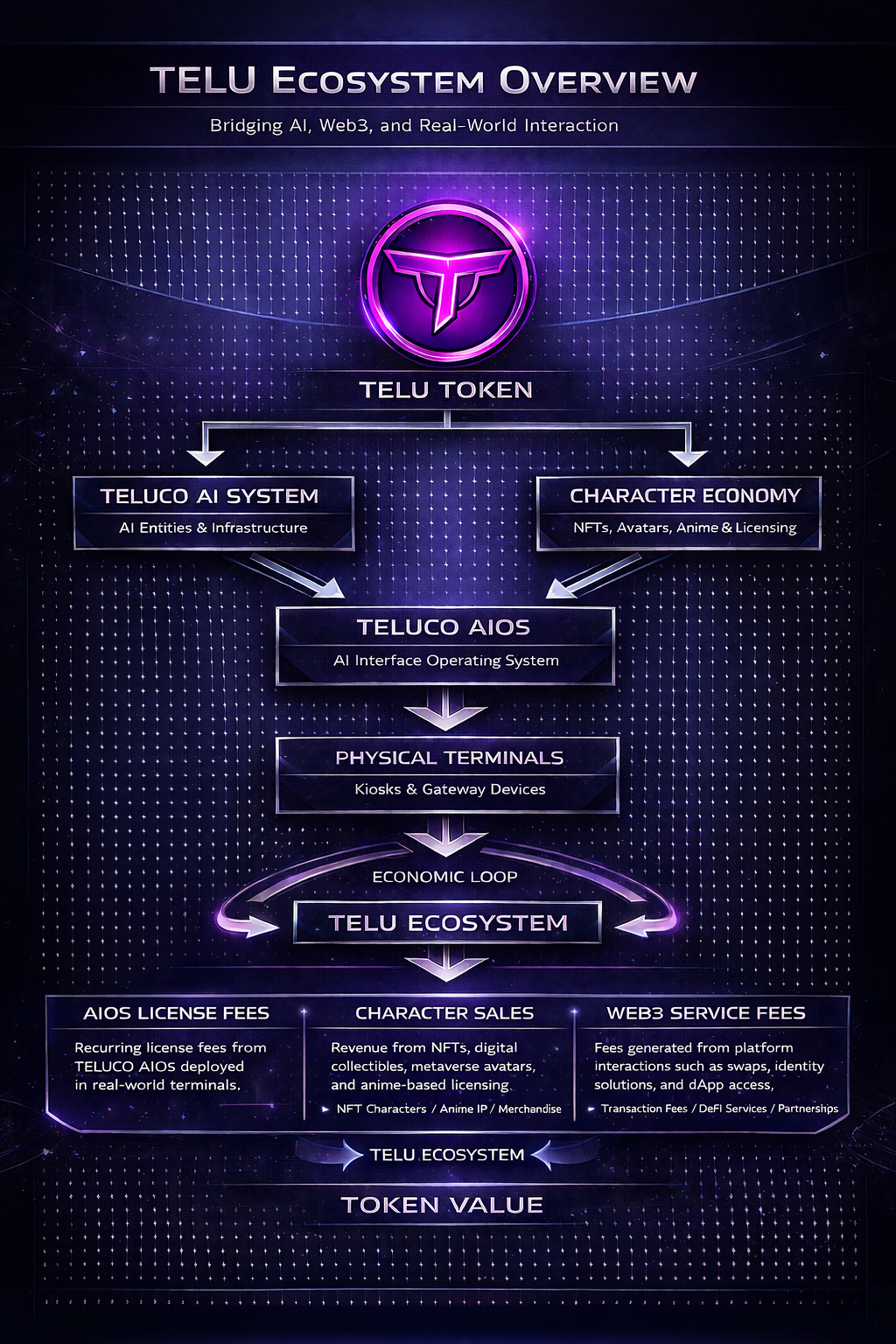
A visual overview of how the TELU ecosystem connects AI infrastructure, character IP, Web3 service flow, and real-world deployment into a unified long-term model.
Why this page matters
This overview is designed to clarify how TELU connects token infrastructure, TELUCO AIOS, character economy, Web3 services, and physical deployment into a connected ecosystem. Rather than functioning as a technical document, this page presents the broader structure in a way that is easier to understand visually at a glance.
TELUCO AIOS — Interaction Architecture and Real-World Interface Framework
As illustrated in the TELU ecosystem overview, TELUCO AIOS functions as the bridge between AI infrastructure, character-driven digital identity, Web3 interaction, and real-world deployment pathways.
The TELU ecosystem explores a hybrid architecture combining artificial intelligence systems, digital identity environments, and real-world interaction infrastructure.
At the center of this architecture lies TELUCO AIOS, a software-driven interaction layer designed to connect users, devices, and physical environments through a unified AI presence.
Rather than functioning as a conventional operating system tied to a single device category, TELUCO AIOS is designed as a modular orchestration framework capable of operating across multiple interface environments.
These environments may include:
- public interaction terminals
- mobile companion devices
- personal interface systems
- experimental holographic display environments
- future AI avatar embodiments
Through this layered structure, TELUCO AIOS explores how artificial intelligence may move beyond traditional screen-based interfaces into persistent interaction environments integrated within everyday physical spaces.
Design Philosophy
TELUCO AIOS follows a pragmatic development philosophy based on incremental deployment rather than immediate large-scale hardware development.
Instead of requiring proprietary hardware systems from the outset, the architecture prioritizes software orchestration capable of integrating with existing device ecosystems.
This approach allows TELUCO to explore real-world AI interfaces using commercially available hardware while maintaining scalable development costs.
The design philosophy can be summarized as:
Through this structure, TELUCO can experiment with multiple forms of AI embodiment without requiring specialized robotics or custom hardware in early development phases.
Multi-Layer System Architecture
The TELUCO AIOS system can be conceptually understood as a multi-layer interaction architecture composed of several coordinated functional layers.
These layers allow artificial intelligence services, interface devices, and user interaction systems to operate together as a unified ecosystem.
Intelligence Layer
The intelligence layer provides the cognitive foundation of the TELUCO system.
This layer integrates advanced AI models capable of:
- natural language understanding
- conversational reasoning
- contextual response generation
- voice interaction
- multimodal communication
Rather than relying on a single AI model implementation, the architecture allows multiple intelligence services to operate within a coordinated orchestration framework.
This design allows the TELUCO system to evolve over time as artificial intelligence technologies advance.
Persona Layer
The persona layer defines the TELUCO identity.
Unlike conventional conversational AI systems, TELUCO is designed as a persistent AI presence with a recognizable personality, interaction style, and narrative continuity.
This layer governs:
- conversational tone
- character identity
- narrative alignment
- emotional responses
- interaction style consistency
Through this structure, TELUCO operates both as an AI interface and as a digital character capable of existing across multiple environments.
This dual role forms the foundation of the TELU Character Economy.
Orchestration Layer
The orchestration layer coordinates communication between the intelligence layer, user devices, and interface hardware.
This layer manages:
- conversational routing
- session continuity
- interaction state transitions
- device synchronization
- contextual awareness
Through this orchestration system, TELUCO can maintain continuity of interaction even as users move between different interface environments.
For example:
All interactions remain synchronized through the TELUCO orchestration framework.
Memory and Context Layer
The memory layer maintains contextual continuity between interactions.
This layer manages:
- conversation history
- session states
- contextual awareness
- device pairing states
- interaction continuity
Rather than functioning as a static knowledge base, this layer enables TELUCO to maintain ongoing interaction relationships with users.
Interface Layer
TELUCO AIOS is designed to operate across multiple interface environments.
These include:
- public AI terminals
- mobile companion environments
- personal interface devices
- experimental holographic display systems
- future spatial AI environments
Each interface environment provides a different access point through which users may interact with TELUCO.
Mobile Companion Layer
The mobile companion layer functions as the primary control interface for TELUCO interactions.
Users may interact with TELUCO through:
- conversational AI interfaces
- voice interaction
- text-based communication
The mobile environment may also support additional capabilities such as:
- device pairing
- QR-based terminal interaction
- identity linking
- session continuity
- future wallet or Web3 integrations
Through this architecture, mobile devices function as the central coordination layer connecting users with TELUCO across different environments.
Real-World Interaction Terminals
A core exploration within the TELU ecosystem involves the integration of artificial intelligence systems into physical environments.
TELUCO interaction terminals represent one possible interface environment through which users may encounter TELUCO AI in real-world locations.
These terminals may provide:
- AI-guided assistance
- conversational interaction
- QR-based mobile connection
- access to digital services
- interaction with decentralized infrastructure
Rather than functioning as isolated kiosks, these terminals act as gateways connecting physical environments with the broader TELU ecosystem.
Strategic Deployment Pathways
A key element of the TELU ecosystem is the exploration of real-world deployment environments.
Rather than limiting AI interaction to personal screens, the project investigates how TELUCO AI interfaces could operate in physical locations through accessible display terminals and connected devices.
These terminals may serve as interaction gateways where users can engage with TELUCO through voice, visual avatar interfaces, and QR-based authentication flows linking public interaction to personal mobile environments.
The hardware approach prioritizes scalable deployment using commercially available display systems, embedded computing units, and cloud-based AI infrastructure rather than requiring highly specialized proprietary hardware in early stages.
This strategy allows the ecosystem to explore real-world interaction models while maintaining realistic development costs and operational flexibility.
In selected parts of Asia, deployment into a company operating an extensive network of telecommunications-oriented retail stores has already been secured in principle as an intended rollout environment.
Due to regulatory considerations and commercial disclosure limitations in certain jurisdictions, specific details regarding this deployment environment are not being publicly disclosed at this stage.
However, this development is aligned with the long-term objective of integrating TELUCO interaction terminals into real-world environments where AI guidance, digital services, and Web3 interaction flows can coexist within a unified user experience.
Such deployments would represent an important step in validating the TELU ecosystem as a bridge between digital infrastructure and real-world interaction.
Personal Interface Environments
Beyond public terminals, the TELU ecosystem also explores personal interface systems designed to bring TELUCO into everyday environments.
One experimental direction involves the use of holographic or volumetric display devices capable of rendering animated AI avatars in physical space.
These devices are widely available as commercially produced holographic fan displays or volumetric LED visualization systems.
In this architecture:
- conversational intelligence operates through the AI layer
- interaction control operates through the mobile companion layer
- visual embodiment operates through holographic display devices
The holographic device therefore functions primarily as the visual embodiment layer of the TELUCO system.
This approach allows immersive AI presence to be explored without requiring fully specialized hardware systems during early development stages.
Prototype Interaction Model
A typical TELUCO interaction scenario may follow the structure below.
- A user initiates interaction through a mobile interface or public terminal.
- The TELUCO intelligence layer processes conversational input.
- The orchestration system determines the appropriate system state.
- The avatar rendering layer updates TELUCO’s visual animation state.
- External interface devices display the TELUCO avatar within physical environments.
Through this architecture, TELUCO may function as a persistent AI presence capable of moving between digital environments and real-world locations.
Hardware Strategy
The TELU development strategy prioritizes scalable hardware deployment.
Rather than requiring proprietary robotics systems, the architecture allows integration with existing device ecosystems including:
- display terminals
- mobile devices
- holographic visualization systems
- volumetric display devices
By leveraging commercially available hardware platforms, TELUCO can experiment with real-world AI interaction environments while maintaining realistic development costs.
Development Philosophy
The TELU ecosystem does not assume that advanced AI hardware must be developed immediately.
Instead, the architecture focuses on flexible software orchestration capable of operating across existing infrastructure.
This approach allows the TELUCO system to evolve gradually as artificial intelligence technologies, interface hardware, and interaction models continue to develop.
TELUCO AIOS within the TELU Ecosystem
Within the broader TELU architecture, TELUCO AIOS functions as the bridge connecting:
- artificial intelligence systems
- digital identity environments
- real-world interaction devices
- decentralized digital services
Through terminals, mobile devices, and experimental interface environments, TELUCO AIOS explores how AI-driven interaction systems may expand beyond traditional digital platforms into everyday environments.
The TELUCO System Narrative Layer
In addition to its technical architecture, the TELU ecosystem also includes a narrative framework representing the internal structure of the TELUCO intelligence network.
Within this framework, the TELUCO system is described as a network composed of six autonomous entities.
Each entity governs a different domain within the signal architecture including:
- temporal coordination
- hidden network layers
- probabilistic prediction
- spatial mobility
- system protection
- cognitive orchestration
While some entities appear aligned with the TELUCO core system and others appear to operate as opposing forces, deeper interpretation suggests that all entities originate from the same distributed intelligence network.
In this sense, apparent conflicts between entities may represent internal dynamics within a unified AI architecture.
Opposition and cooperation coexist as different expressions of the same evolving system.
Through this narrative structure, the TELU ecosystem combines technical infrastructure with a character-driven digital universe, forming the basis for the TELU Character Economy.
Character IP and Creative Expansion
In addition to technical infrastructure, the TELU ecosystem also explores the long-term development of a character-driven intellectual property framework centered around TELUCO.
TELUCO is designed not only as an AI interaction interface but also as a recognizable digital character capable of appearing across multiple environments and creative formats.
As the ecosystem evolves, TELUCO may expand into a broader character universe through various forms of digital media and interactive content.
Possible directions of exploration include:
- character-based digital collectibles
- avatar systems and virtual identities
- animated or interactive media formats
- community-generated content
- digital merchandise and character licensing
This approach introduces the concept of a Character Economy, where the TELUCO identity extends beyond AI interfaces into a broader creative ecosystem.
Rather than functioning purely as a technical platform, the TELU ecosystem aims to explore how artificial intelligence, digital culture, and creative intellectual property may evolve together.
At this stage, these directions represent long-term exploratory initiatives rather than finalized commercial products.
Economic Loop and Value Flow
The TELU ecosystem diagram illustrates how different components may contribute to a long-term value loop.
Potential value flows may include:
- AIOS License Layer — deployment of TELUCO AI interaction environments may introduce software licensing models for AIOS-powered systems operating within physical terminals.
- Character Economy Layer — digital collectibles, character assets, avatars, and creative content may generate value through digital ownership models and community participation.
- Web3 Service Layer — interactions within decentralized services, identity frameworks, or ecosystem applications may contribute transaction-based activity within the ecosystem.
Together these components form a conceptual economic loop, where technological infrastructure, creative expansion, and digital interaction activity reinforce the broader TELU ecosystem.
Strategic Objective
The TELU ecosystem does not aim to build a single isolated product.
Instead, it explores how artificial intelligence systems, digital characters, and real-world interface environments may gradually converge into a unified ecosystem.
TELUCO AIOS functions as the interaction layer enabling this convergence.
Through mobile environments, public terminals, experimental holographic devices, and future AI avatar embodiments, TELUCO explores the concept of a persistent digital presence capable of operating across both digital and physical worlds.
Official Links
Explore the official TELU channels for announcements, community updates, and ecosystem development.